
If your workouts aren’t working even though you’ve been showing up consistently, the problem probably isn’t your effort. We hear some version of this story every week at our Clearwater gym. Someone commits to a routine, sticks with it for months, and their body barely responds. Or they bounce between programs, classes, and online workouts hoping the next one will be the thing that finally works.
Your body is smart. It adapts to exactly what you give it. When the programming doesn’t challenge your body in the right ways, it stops changing. Not because you’re doing something wrong on purpose, but because no one ever explained the why behind what actually works.
When workouts aren’t working, it usually isn’t because someone is lazy or not trying hard enough. More often, the issue is that the training plan does not give the body the right reason to change.
Here are the six most common training mistakes we see and what to do instead.
Why Your Workouts Aren’t Working: You Don’t Have Real Structure
Bootcamp on Monday. Spin on Wednesday. A random workout from social media on Friday. You’re doing a lot of things, but none of them connect to each other.
This also shows up in a different way. Some people skip the classes and build their own workouts at the gym. But the exercises don’t follow any logical order. A chest exercise, then straight to biceps, then over to a machine because it’s open. There’s no connection between the movements and no reason one comes before the other.
Both versions have the same problem. Your body adapts when it is asked to do progressively harder work in a structured way over time. This is often called progressive overload, and it is one of the basic principles behind strength training. Random workouts, whether they’re random classes or random exercises, don’t ask that of your body. Every time you switch programs or bounce between unrelated movements, your body starts over. It never gets deep enough into any stimulus to actually adapt.
Your body wants to get stronger. You just have to give it a reason. That means sessions where each workout builds on the last, exercises follow a logical order based on how your muscles work together, and the demands on your body increase week to week.
You’re doing the same thing every time
On the other end of the spectrum, some people do have a routine. They follow it and they stick with it. The problem isn’t a lack of structure. It’s that the structure never changes.
A lot of this comes from rules people pick up along the way. Four sets of ten, every exercise, every workout, every week. It feels disciplined. But your body doesn’t care about the rules you read somewhere. It cares about what it needs today.
Your muscles don’t all respond to the same stimulus. Some movements work best with heavier loads and fewer reps. Others respond to lighter weight and higher volume. When you lock yourself into one rep range, you’re only training one adaptation. Your body builds strength in low rep ranges because the load is high enough to recruit your largest muscle fibers. It builds endurance and size in higher rep ranges because the time under tension is longer.
On top of that, your body catches on fast. If you give it the same stimulus for weeks, it adapts and stops responding. Changing rep ranges, adjusting volume, and progressing the load are some of the simplest ways to keep your body moving forward.
You’re chasing weight instead of quality reps
You want to get stronger, so you add more weight. It feels like progress. The problem is that heavier weight with poor technique doesn’t build the muscle you think it does.
When your form breaks down, your body compensates. It shifts the load to whichever muscles can handle it, even if those aren’t the ones you’re trying to train. You end up doing a chest press with your shoulders, or a squat with your lower back. Your body is too smart to let the weight just fall. It recruits whatever it can to get through the rep.
That’s where injuries come from. The muscles doing the compensating weren’t designed for that load. They’re smaller, weaker, and now they’re absorbing force they were never meant to handle. Do that enough times and something gives.
You can often get a better workout by lowering the weight and cleaning up your form. Small changes in positioning and control make the target muscle work dramatically harder. It doesn’t feel as impressive, but your body doesn’t care about impressive. It cares about the stimulus.
You’re not connecting with the muscle
You’re doing the exercise. The weight goes up, the weight comes down. But if you asked yourself where you actually feel it, the answer might surprise you.
We see this constantly when coaching at our Clearwater studio. Someone’s doing a back exercise and they feel it entirely in their arms. That’s not a back workout. That’s an arm workout with extra steps. Or someone’s doing a glute exercise and all the tension goes to their lower back. That’s not because the exercise is wrong. It’s because they haven’t developed the ability to contract the muscle they’re actually trying to train.
This is called mind-muscle connection, and it’s a neurological skill. Your brain has to learn how to fire the right muscle at the right time. Without that connection, you’re just moving weight from point A to point B. The movement happens, but the deep engagement of the intended muscle doesn’t.
It’s surprising how many people have trained for months or even years and have never actually engaged the muscles they think they’re working. Once you develop that connection, every single rep counts for more. Your training becomes significantly more effective because you’re no longer wasting effort on muscles that shouldn’t be doing the work.
You’re doing too much cardio and not enough strength training

If you’re spending most of your gym time on the treadmill, the bike, or in high-intensity classes, you’re not wrong for thinking that burns fat. It does. But here’s the part most people miss: when you overdo cardio without enough strength training, your body starts burning muscle for energy.
Muscle is the engine behind your metabolism. The more muscle you carry, the more calories your body burns all day long, even while you sleep. When you lose muscle to excessive cardio, that engine shrinks. Your metabolism slows, fat loss stalls, and you end up working harder for fewer results.
There’s another piece to this. Too much high-intensity cardio keeps cortisol elevated, which puts your body into a stressed-out state. That makes it even harder to build muscle and even harder to lose fat.
Most people don’t need more cardio. They need more muscle. Strength training carries the load and cardio rounds it out in a balanced way. Most people have that ratio flipped.
Nobody is watching your form
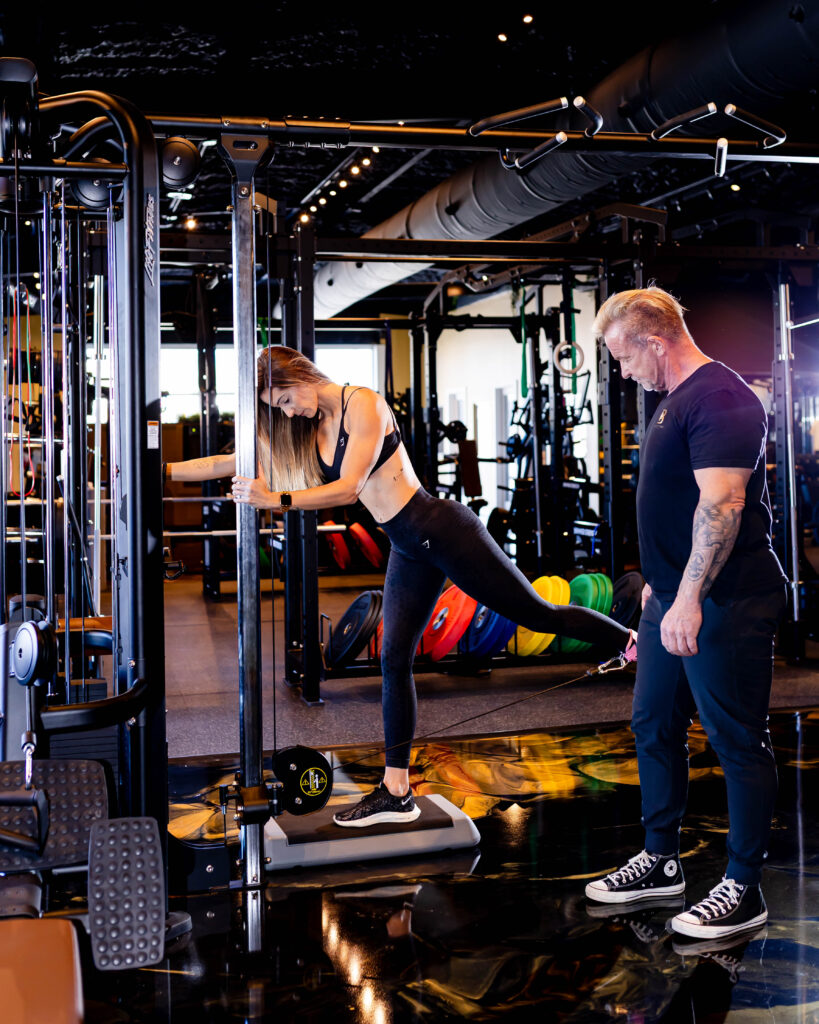
Walking into a gym without a plan is hard. Walking in without anyone to correct your form, adjust your programming, or push you past the point where you’d normally stop is even harder.
A lot of people turn to group classes for structure, and that makes sense. The problem is that most group classes are built around a template. The instructor might be great and the workout might be decent, but it wasn’t created for you. It was created for a room full of people with completely different bodies, goals, and limitations. When there are 20 or 30 people in a room, nobody’s watching your form closely enough to correct it. Nobody’s adjusting the workout based on an old shoulder injury or the fact that your body needs more hip work than upper body.
A coach changes all of that. Your technique gets corrected in real time. Your workouts are built around your body, your goals, and what the assessment reveals. Your programming evolves based on how your body responds. Instead of spending the first 15 minutes wondering what to do, you walk in and everything’s already mapped out.
For a lot of people, coaching is the thing that turns years of effort into actual results.
What to do about it
Every one of these mistakes has the same root cause. Your body is incredibly adaptive, and it needs the right input to change. Not just more input. Not just harder input. The right kind.
Training that works follows a few principles. Exercises build on each other in a logical order. Rep ranges change depending on the movement and the goal. Technique comes before load. You learn to engage the right muscles so every rep counts. Strength training plays the lead role, even if your goal is fat loss. And the program evolves over time instead of repeating the same thing week after week.
When all of those pieces come together, results come faster. Strength improves. Your body starts changing in ways you’d been hoping for. Training feels like it’s finally working with your body instead of against it.
If your workouts aren’t working right now, the answer is not always to do more. Sometimes the better move is to get clearer structure, better coaching, and a plan that actually progresses.
Frequently Asked Questions
How often should I work out to see results?
The minimum is three times per week. If you go three times, you’d train your whole body almost every session. If you want shorter workouts, you can split the routine across four to five days. The sweet spot for most people is three to five days per week with active recovery on off days like walking, stretching, or light core work.
Why am I not seeing results even though I work out regularly?
The most common reasons are lack of structure in your programming, doing the same workout every time, poor form that shifts the work to the wrong muscles, too much cardio without enough strength training, and no coaching to correct what you can’t see on your own. Consistency matters, but only when the training is designed to challenge your body in the right ways.
Should I do cardio before or after weight training?
Always after. You can do five to ten minutes before as a warm-up, but anything more than that depletes the energy you need for strength training. Save longer cardio sessions for after your workout or on separate recovery days.
How long does it take to see results from working out?
You’ll feel results before you see them, sometimes within a few sessions. Visible changes like muscle tone and definition come at the earliest around two months. For most people, it takes six months to a year of consistent, structured training to truly get the body they’re working toward.
Do I need a personal trainer or can I follow a workout plan?
A workout plan can be a starting point, but it can’t adjust to how your body feels, correct your form, or account for your specific strengths and weaknesses. Most people get a fraction of the results they could because the plan doesn’t match what their body actually needs. A coach catches things in real time that a plan on paper can’t.
Can too much cardio hurt my progress?
Yes. When you overdo cardio without enough strength training, your body can start breaking down muscle for energy. That slows your metabolism and makes fat loss harder over time. Most people don’t need more cardio. They need more strength training with cardio in a supporting role.
If any of this sounds familiar, we put together a free guide that breaks down all six mistakes in detail with specific fixes for each one. You can download it here.
And if you want someone to look at your specific situation, the best place to start is a free consultation at our Clearwater studio. We’ll talk about your goals, your history, and whether our personal training programs are the right fit for where you are right now.